
The production of pump rotor manufacturing components requires a delicate balance between complex geometry and strict mechanical tolerances. As global demand for high-viscosity fluid transport increases, the industrial sector is shifting away from traditional milling toward high precision thread whirling. This guide explores the technical nuances of rotor thread whirling, providing a data-driven roadmap for optimizing throughput and cost effectiveness.
The Geometry Challenge: Achieving Eccentric Precision in Rotor Production
Achieving high precision in progressive cavity pump (PCP) rotors requires managing the relationship between eccentricity and the helical lead. Rotor thread whirling addresses these challenges by utilizing a synchronized, multi-cutter head that compensates for tool pressure, ensuring consistent thread pitch even in slender, vibration-prone workpieces.
The fundamental difficulty in pump rotor manufacturing lies in the rotor’s eccentricity ($e$). Unlike standard cylindrical threads, a PCP rotor is an eccentric screw that must maintain a perfect interference fit with its stator. Any deviation in the cross-sectional symmetry or the helical path leads to premature stator wear and hydraulic inefficiency.
Managing Thread Pitch Accuracy and Lead Deviations
In long-form rotor production (often exceeding 5000mm), the “Slenderness Ratio” becomes a critical failure point. Traditional CNC machining methods often struggle with tool deflection because the cutting force is concentrated on a single point. Whirling machines solve this by distributing cutting forces across multiple inserts—typically 6 to 12—within a rotating ring.
- Vibration Dampening: The tangential entry and exit of the whirling cutters create “comma-shaped” chips, which significantly reduce the radial pressure exerted on the rotor.
- Lead Consistency: By maintaining constant material support through guide bushing (in Swiss-style setups) or high-rigidity steady rests, lead deviations are kept within ±0.01mm per meter of length.
Thread Whirling vs. CNC Milling: The Cost-Effectiveness Benchmark
Comparing thread whirling to conventional cnc machining reveals a 3x to 5x increase in throughput. Whirling machines offer superior cost effectiveness by completing the profile in a single pass, eliminating secondary grinding, and extending tool life through improved heat dissipation during the cutting external threads process.
For years, CNC milling was the standard for thread machining in the pump industry. However, as material requirements shifted toward hardened tool steels and stainless alloys (HRC 30-45), milling became a bottleneck due to excessive cycle times and heat-induced warping.
Throughput Analysis: Reducing Cycle Times with Multi-Cutter Whirling Heads
A side-by-side comparison of thread machining technologies demonstrates why high-volume manufacturers are pivoting to whirling.
| Metric | CNC Thread Milling | Thread Whirling (SG/Whirl Series) |
| Machining Passes | 3–5 (Roughing + Finishing) | 1 (Single Pass) |
| Cycle Time | 100% (Baseline) | 25% – 35% |
| Surface Finish (Ra) | 1.6 – 3.2 $\mu m$ | 0.4 – 0.8 $\mu m$ |
| Tool Life | Moderate (Heat concentration) | High (Interrupted cutting cooling) |
| Setup Complexity | Low | Medium |
Related Products
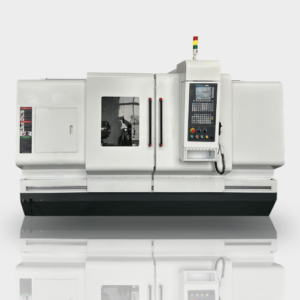
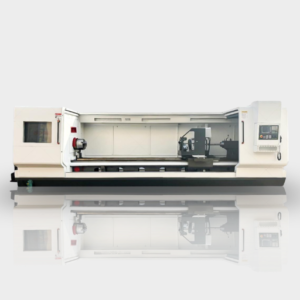
Surface Integrity: Eliminating Post-Processing through Superior Chip Evacuation
One of the hidden factors in cost effectiveness is the elimination of post-process grinding. Whirling machines operate at higher peripheral speeds, but because the contact time per insert is minimal, the heat is carried away by the chips. This prevents the “white layer” or thermal softening often seen in heavy milling operations. [Source: Leistritz/Machining Science].
Critical Machining Parameters for High-Precision Rotors
Precision in cutting external threads is governed by the synchronization of the whirling head rotation ($n_W$) and the workpiece feed. For high precision rotors, maintaining a surface finish of $Ra$ 0.4 $\mu m$ is essential to minimize friction against the stator, directly impacting thread pitch longevity.
In pump rotor manufacturing, the interaction between the rotor and the elastomer stator is the primary driver of pump life. If the thread machining process produces a rough surface, the “interference fit” creates excessive friction, leading to “stator blowout.”
Calculating Feed Rates for Hardened Tool Steels and Stainless Alloys
To achieve high precision, the feed rate must be meticulously calibrated based on the material’s hardness. For 316L Stainless Steel or 40CrNiMo (chrome-plated), the following parameters are industry standards:
- Cutting Speed ($V_c$): 100–180 m/min for carbide inserts.
- Workpiece Rotation ($n_R$): Typically 3–30 RPM depending on diameter.
- Surface Finish: Achieving $Ra$ 0.4–0.6 $\mu m$ often eliminates the need for polishing.
Impact of Cutting External Threads on Material Fatigue and Stator Wear
The mechanics of cutting external threads via whirling ensure that the “scallop height” (the peaks left by the tool) is significantly lower than in milling. This profile symmetry ensures that the thread pitch remains consistent across the entire 6000mm length, preventing localized pressure points that cause material fatigue in the stator.
Engineering for Cost-Effectiveness: Beyond the Machine Tool
Total cost effectiveness in rotor thread whirling is achieved through maximized Tooling ROI and automation. By utilizing long-life carbide inserts and integrating robotic loaders, manufacturers can reduce the Total Cost of Ownership (TCO) by up to 40% compared to manual cnc machining setups.
Procurement managers often focus on the initial capital expenditure of whirling machines. However, the true value lies in the “Yield per Shift.”
Tooling ROI: Carbide Insert Longevity in Continuous Whirling Operations
Because whirling machines use an interrupted cutting motion, each insert has time to cool during every revolution. This “thermal relief” allows for the use of more aggressive grades of carbide or CBN (Cubic Boron Nitride) without the risk of catastrophic edge failure.
- Standard Milling Tool Life: 15–20 parts/edge.
- Whirling Insert Tool Life: 80–120 parts/edge. [Source: Industry Internal Benchmarking].
Automation Integration: Reducing Labor Costs in High-Volume Rotor Runs
Modern cnc machining centers for rotors are now equipped with automatic steady-rest positioning and bar loaders. This allows for “lights-out” manufacturing of pump rotor manufacturing components, where the machine automatically adjusts for thermal expansion to maintain thread pitch accuracy over an 8-hour shift.
Quality Assurance: Validating Pitch Consistency and Profile Symmetry
Validating high precision in eccentric helical profiles requires advanced CMM protocols. Using cylindrical coordinate measuring, technicians must verify the thread pitch, eccentricity, and major diameter at multiple cross-sections to ensure compliance with ISO 15136-1 standards for PCP systems.
The final pillar in manufacturing is verification. A rotor may look perfect, but a thread pitch error of just 0.05mm can reduce pump efficiency by 15%.
CMM Protocols for Eccentric Helical Shapes
Coordinate Measuring Machines (CMM) must be programmed for “Scanning Mode” rather than “Point-to-Point” to capture the full geometry of the rotor thread whirling path.
- Eccentricity Verification: Checking the offset of the helix center relative to the rotor axis.
- Pitch Lead Mapping: Measuring the distance between threads over the full length (e.g., 6000mm) to detect cumulative error.
- Symmetry Analysis: Ensuring the “lobe” profile is uniform, which is critical for maintaining the seal inside the stator. [Source: ISO 15136-1:2009].
Are you looking to optimize a specific rotor material, or would you like a detailed ROI breakdown for a particular machine model? Feel free to contact us!
Technical Research & Verification List
- ISO 15136-1:2009: Downhole equipment — Progressing cavity pump systems for artificial lift. [https://www.iso.org/standard/43118.html]
- Machining Science and Technology Journal: Thermal effects in interrupted cutting processes.